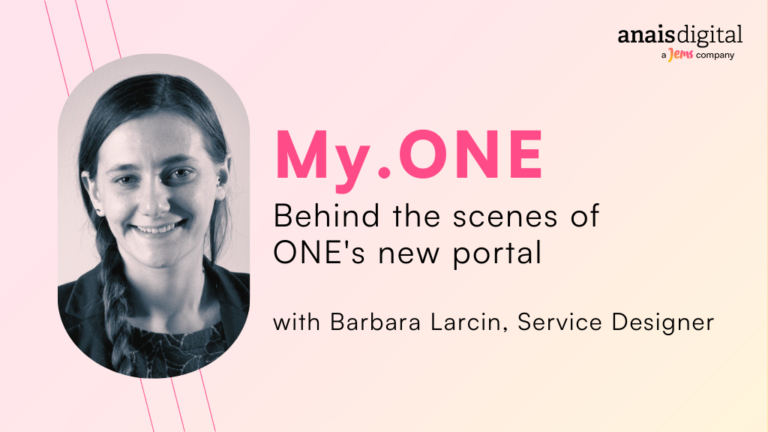
At JEMS Belgium, we design innovative digital solutions that truly serve our users. One of our latest projects, developed in collaboration with the ONE (Office de la Naissance et de l’Enfance), is My.ONE—a portal that centralizes a wide range of resources for parents.
To learn more about how this project came to life, we spoke with Barbara Larcin, Service Designer, who guided the ecosystem throughout its redesign.
Can you introduce yourself?
My name is Barbara Larcin, and I’m a Service Designer at JEMS Belgium.
What does your role as a service designer involve?
Service design is about orchestrating collaboration across all project stakeholders to ensure that everyone contributes value and moves in the same direction.
Concretely, this means facilitating workshops involving both internal teams (designers, developers) and client stakeholders. In the case of My.ONE, that meant working closely with various departments at ONE, including directors and their teams.
What was the purpose behind the redesign of “Premiers Pas”?
The original Premiers Pas portal was focused on helping parents find childcare providers, like crèches or childminders. With My.ONE, the goal was to broaden the scope and create a more comprehensive resource.
Now, parents can also find medical consultations offered by ONE, as well as extracurricular activities and programs for older children—like tutoring, community activities, and vacation camps.
What challenges did you face in centralizing so much information?
The main challenge was facilitating collaboration between departments that had never worked together before. As a service designer, my role was to bring them around the same table, align their priorities, and help them co-create a solution that genuinely responds to users’ needs.
What methodologies did you apply to support this transformation?
We followed a design thinking approach. First, we explored user needs through interviews and co-creation sessions. Then we selected and refined the best solutions to prototype and develop. Throughout, we supported the teams—designers, developers, and stakeholders—to turn ideas into a viable product.
What was the most exciting part of the project?
The fact that this platform speaks directly to the general public made it especially meaningful. My.ONE helps parents see ONE in a new light—not just as a logo on a crèche, but as a long-term partner throughout their child’s journey, from birth to adolescence.
It’s the first tool that makes this support visible, interactive, and user-friendly—thanks to features like the map, where parents can find services nearby.
What were the key challenges during implementation?
One of the biggest challenges was phasing the work. With so many great ideas on the table and so many stakeholders involved, the task was to sequence improvements and feature rollouts in a way that made sense for everyone.
How did you manage collaboration between disconnected departments?
We acted as facilitators, setting up a series of collaborative workshops. These weren’t just about brainstorming ideas—they also helped align strategy, define decision points, and create shared milestones across teams.
How should parents feel when visiting the new site?
We want the experience to be simple and intuitive. My.ONE isn’t an informational website like ONE.be—it’s a service-oriented tool.
Parents will be asked to enter their address and then see nearby services directly on a map. It works similarly to platforms like Google Maps or Airbnb, but designed specifically for parenting needs. We’ve tested and refined the experience so it feels natural, even to users unfamiliar with digital platforms.