How STIB redesigned its website to meet the real-time needs of urban commuters

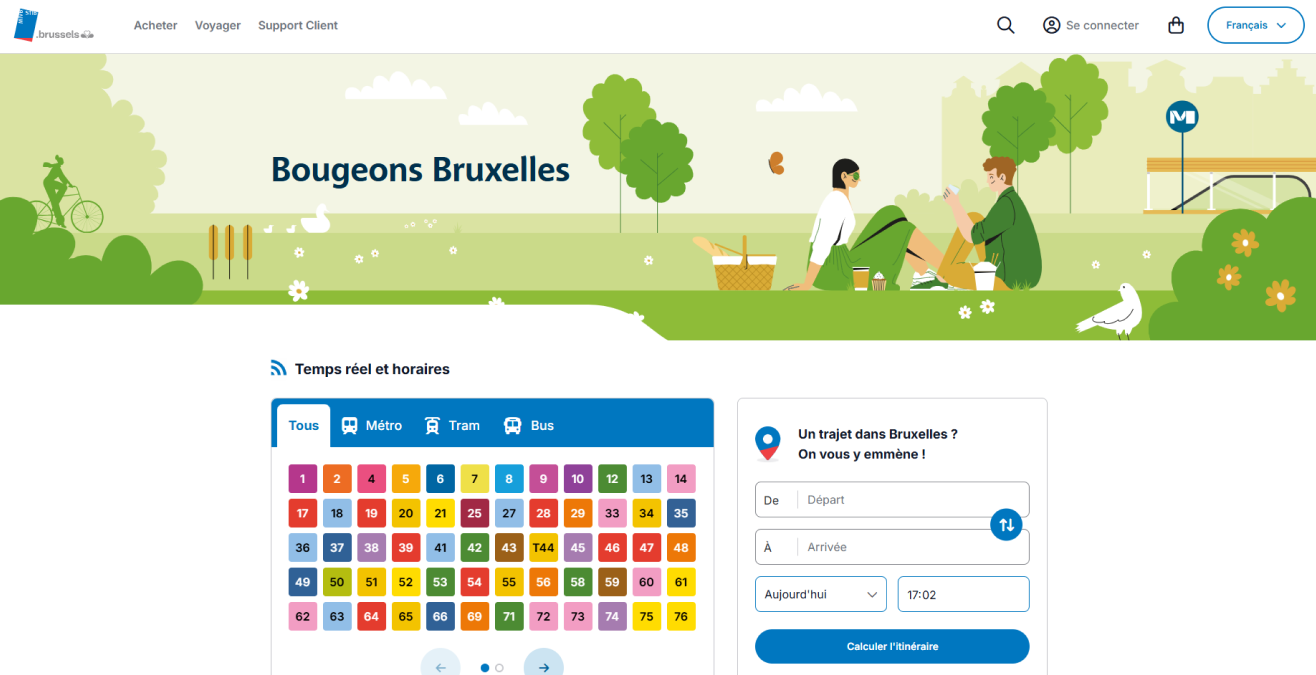
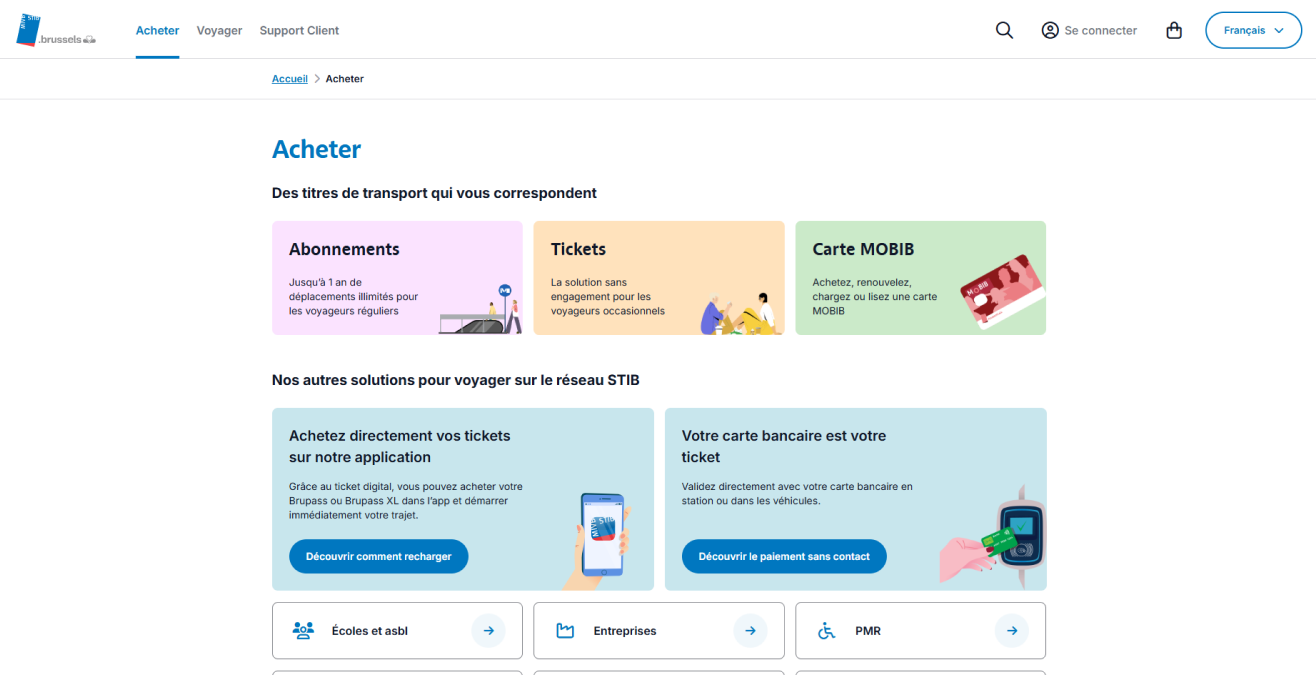
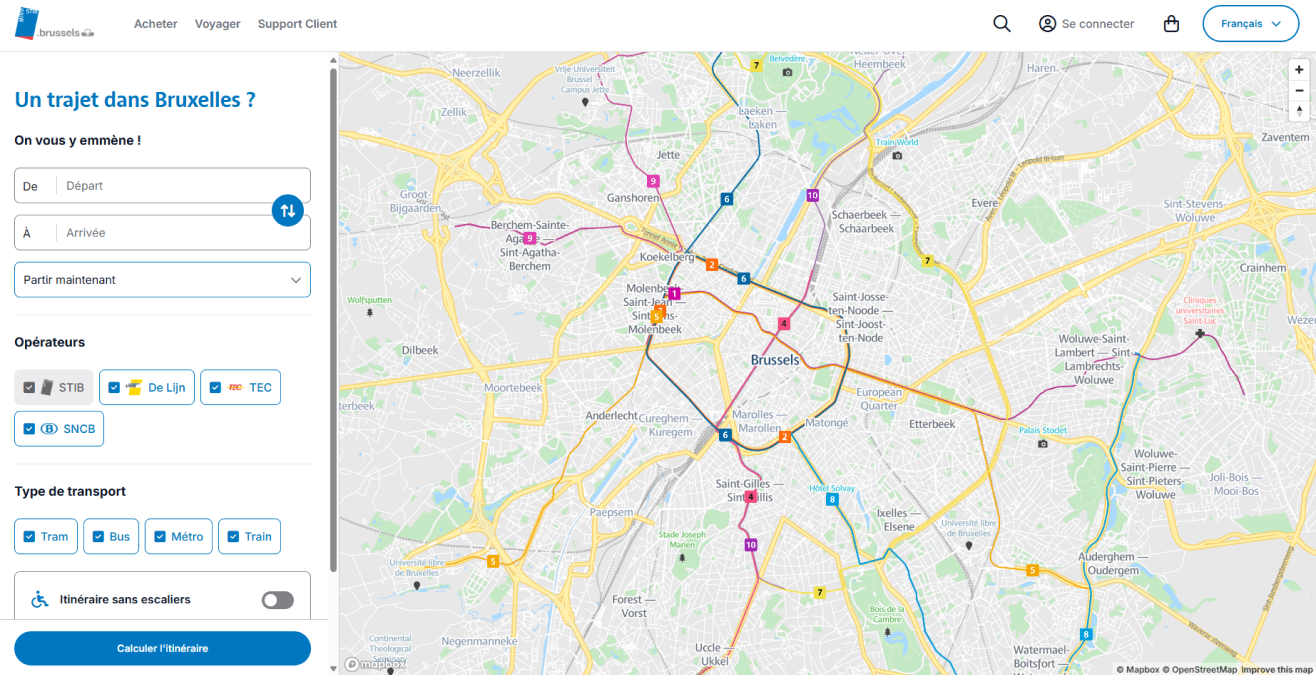
To better serve the daily needs of Brussels commuters, STIB set out to completely redesign its website — with a focus on mobile-first navigation, seamless subscription purchases, and real-time travel information.

The Brussels Intercommunal Transport Company (STIB) is the main public transport operator in the Brussels-Capital Region. It manages an extensive multimodal network of metro, tram, and bus lines, serving over a million journeys per day. As a key player in urban mobility, STIB is committed to providing accessible, sustainable, and efficient transport solutions for residents, commuters, and visitors alike.

Public Transport

Public Sector

01. Challenge

STIB aimed to eliminate friction in the user journey by making essential information — like routes, schedules, and service disruptions — easier to access through a seamless, mobile-optimized experience.

02. Approach

We implemented a comprehensive and structured UX approach:

  • Mental model based on insights from 40+ user interviews

  • Navigation flowcharts to rebuild the site architecture

  • Design Studio workshops with key stakeholders

  • Continuously tested wireframes, refined into high-fidelity designs

  • Fully documented design system in Figma

  • Over 145 user tests conducted throughout the sprints

03. Impact

The results of our intervention at STIB were highly positive:

  • Strongly positive feedback from both end users and internal stakeholders

  • A scalable UX approach that can be replicated across other STIB platforms

  • Strengthened alignment between UX, business, and tech teams through collaborative workshops and user testing

  • Quantitative impact analysis currently underway on the client side

01. Challenge

STIB aimed to eliminate friction in how users accessed key information — such as routes, schedules, and service disruptions — especially in on-the-go situations where speed and clarity are essential.

The objective was to create a mobile-first experience that matched the real-life needs of commuters navigating the city in real time.

"The biggest challenge was designing for users in motion — like a commuter rushing to catch a connection, quickly checking their phone between two metro stops to see if there’s a delay. In those moments, users need instant, reliable information with zero friction."

Pauline Lagage
UX Researcher @ JEMS

02. Approach

To meet STIB’s user experience challenges, JEMS deployed a comprehensive and structured UX approach.

We started by conducting over 40 in-depth user interviews, which informed a detailed mental model to better understand real user expectations and behaviors.

Based on these insights, we rebuilt the site’s architecture using navigation flowcharts designed to support intuitive and goal-oriented journeys.
Co-creation was central to the process: we ran Design Studio workshops with key stakeholders to align strategic priorities with user needs.

Wireframes were iteratively tested and improved throughout the project, then translated into high-fidelity designs. In total, over 145 user tests were carried out during the sprints — allowing us to validate assumptions, reduce risk, and continuously refine the experience.

To ensure consistency and scalability, a fully documented design system was created in Figma.

Curious about mental models and how they can transform your digital projects? Read the interview of Pauline Lagage, Senior UX Researcher at JEMS Belgium.

03. Impact

The impact of our work with STIB was both immediate and promising for the long term.

User feedback highlighted a noticeable improvement in ease of access to essential information, especially on mobile — confirming the value of a user-centered redesign. Internal stakeholders also responded positively to the process, noting stronger collaboration and shared ownership across departments.

Beyond the success of the project itself, the UX methodology we implemented proved to be scalable and is now being considered for application across other STIB platforms — opening the door for broader organizational impact.

Thanks to the co-creation workshops and continuous user testing, the alignment between UX, business, and tech teams has significantly improved. A quantitative analysis is currently underway to further measure the value delivered.

Improved user experience

Clearer access to essential info, especially on mobile — confirmed by strong user feedback.

Cross-team alignment

Stronger collaboration between UX, business, and tech through co-creation and testing.

Scalable UX methodology

A replicable approach now considered for other STIB platforms.

Need help with your next digital project?

Our experts are ready to accompany you every step of the way.

Select a date and time to book your free strategic consultation. This is your chance to connect with one of our experts, explore your project in depth, and start turning your vision into reality.

Free of charge

Yep, first meeting is on us :)

Without commitment

You sleep on it and let us know !

Related cases

MyONE_illustration case

ONE

Optimizing internal organizational processes to develop a local, high-quality digital portal centralizing key information for young parents.

Dstny

Revamping the software's user experience by developing a comprehensive app that is easy to maintain and allows for the addition of new features.
Jems Benelux
Privacy Overview

This website uses cookies so that we can provide you with the best user experience possible. Cookie information is stored in your browser and performs functions such as recognising you when you return to our website and helping our team to understand which sections of the website you find most interesting and useful.